
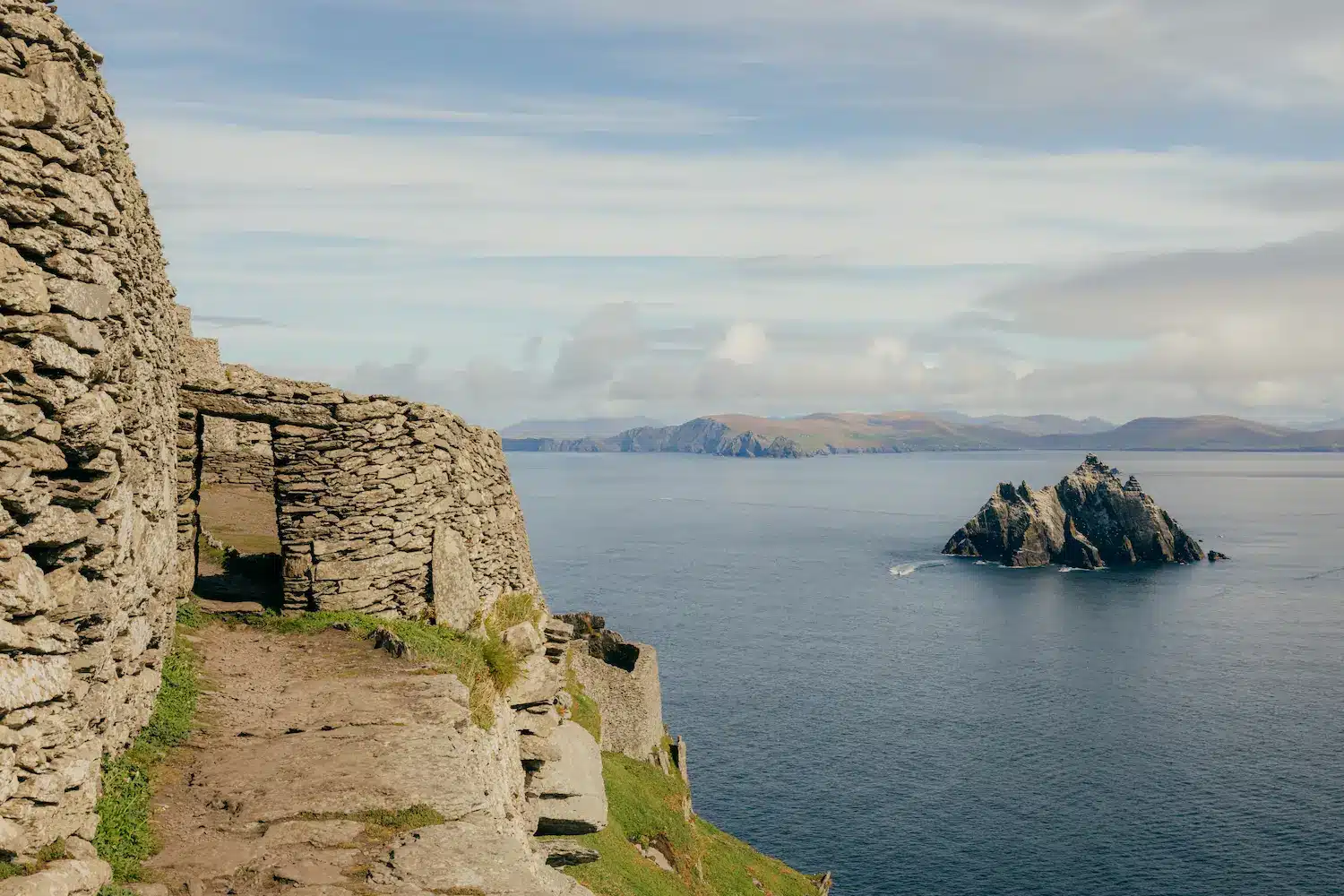
If you draw a line on a map linking several sites dedicated to St. Michael, it runs from Skellig Michael on Ireland’s Atlantic coast across Europe to Mount Carmel in Israel. This alignment is often referred to as the St. Michael Line or the Sword of St. Michael.
There is no clear historical evidence that this alignment was intentionally created. However, the consistency of the line, combined with the importance of the sites it connects, has made it one of the most intriguing and widely discussed geographical alignments associated with Skellig Michael.
What is the St. Michael Line?
The St. Michael Line is a modern term used to describe a series of religious sites associated with St. Michael the Archangel that appear to fall along a broadly straight path across Europe and into the Middle East.
The locations along this line are:
- Skellig Michael (Ireland)
- St Michael’s Mount, Cornwall (England)
- Mont-Saint-Michel (France)
- Sacra di San Michele (Italy)
- San Michele Arcangelo, Monte Sant’Angelo (Italy)
- Monastery of the Taxiarch Michael Panormitis, Symi (Greece)
- Mount Carmel (Israel)
When viewed together, these sites form a line that stretches thousands of kilometres. It is not perfectly straight in strict scientific terms, but it is close enough to be immediately noticeable.

A remarkable alignment
There is no historical record showing that these sites were planned as part of a coordinated system. They were established in different centuries, by different communities, and within very different cultural contexts. Even so, the alignment remains remarkable.
Across such a distance, the fact that multiple significant religious sites dedicated to the same figure can be connected in a near-linear path is unusual. It is this combination of scale, consistency, and shared symbolism that gives the idea its lasting appeal. Some interpret it as coincidence, while others see it as reflecting deeper patterns in how sacred places were chosen and understood.
Why St. Michael and why these places?
St. Michael the Archangel is traditionally associated with high places, remote and exposed landscapes, natural boundaries such as coastlines and mountains, and protection and guardianship. Many sites dedicated to St. Michael are located in places that feel physically and symbolically set apart. This includes tidal islands, mountain ridges, and isolated rock formations.
Skellig Michael is one of the most extreme examples of this. Located in the Atlantic approximately 12 kilometres off the Kerry coast, it sits at the outer edge of early medieval Europe. It is difficult to access, highly exposed, and visually dominant in the landscape. When viewed in this context, the alignment becomes easier to understand. It reflects a shared tendency to place important religious sites in locations that feel elevated, remote, and significant.
Why the idea continues to resonate
The St. Michael Line continues to attract attention because it brings together several powerful elements. It connects well-known religious sites across multiple countries. It is linked by a shared dedication to the same figure. Each location sits in a dramatic and visually striking landscape. Most importantly, it can be understood instantly by looking at a map.
Skellig Michael’s place in the line
Skellig Michael is the western point of the Sword of St. Michael. The monastery on the island represents one of the most extreme expressions of early Christian monastic life. The monks chose to live in isolation, building their settlement on a narrow terrace high above the Atlantic. This decision was driven by religious devotion, a search for solitude, and the idea of withdrawing to the edge of the known world.
Visiting Skellig Michael today
Today, Skellig Michael is best understood as a UNESCO World Heritage Site with both cultural and ecological importance.
If you are planning a visit, the main focus should be on:
- The monastic structures and how they were built
- The physical climb and layout of the site
- The Atlantic environment and surrounding wildlife
The idea of the St. Michael Line adds an additional layer of interest, but it is not necessary to appreciate the significance of the island itself. For many visitors, it is this combination of history, landscape, and interpretation that makes Skellig Michael such a compelling place to experience.