A landing tour to Skellig Michael is one of the most unique experiences on the Irish coast. The full journey takes close to five hours from departure to return, including a 45 minute crossing each way and approximately two and a half hours on the island.
The tour is not suitable for everyone, and we do not allow children under the age of 14. To reach the monastery, you must climb 618 uneven stone steps with no handrails or safety barriers, so you need to be confident on steep, exposed ground and comfortable with heights.
This guide sets out exactly what the day involves, so you can prepare properly and decide whether the landing tour is right for you.
Departure from Portmagee Marina
The Skellig Michael landing tour departs from the marina in Portmagee Marina, County Kerry. Portmagee is a small fishing village that serves as the primary hub for access to the islands. There are several areas to park in Portmagee, all free of charge. The landing tour season runs from 9th May to the 30th of September.
Departure times are typically between 8:00 am and 12:30 pm. Because sea conditions and tidal windows change daily, the time you selected when you made your booking is not always the final departure time on the day. You will receive your estimated departure time when you check in online the day before your tour. You will also be advised of the time to arrive at the marina in the morning.
Departures can be delayed by several hours if sea conditions are unfavourable in the morning. You should plan for the possibility that the tour may not finish until around 5:30 pm if the tour is delayed.
When you arrive in Portmagee, our crew will meet you at the entrance of the marina, which is just in front of the Skellig Seafront Restaurant. The crew will advise you of further updates, if there are any, and take you to the boat. Once on board, they will give a safety briefing and outline the expected sea conditions for the day. You must listen carefully to all their instructions.
Mandatory Gear and Equipment
Safety on Skellig Michael is strictly enforced, and having the correct gear is a requirement for landing. The most critical item is footwear.
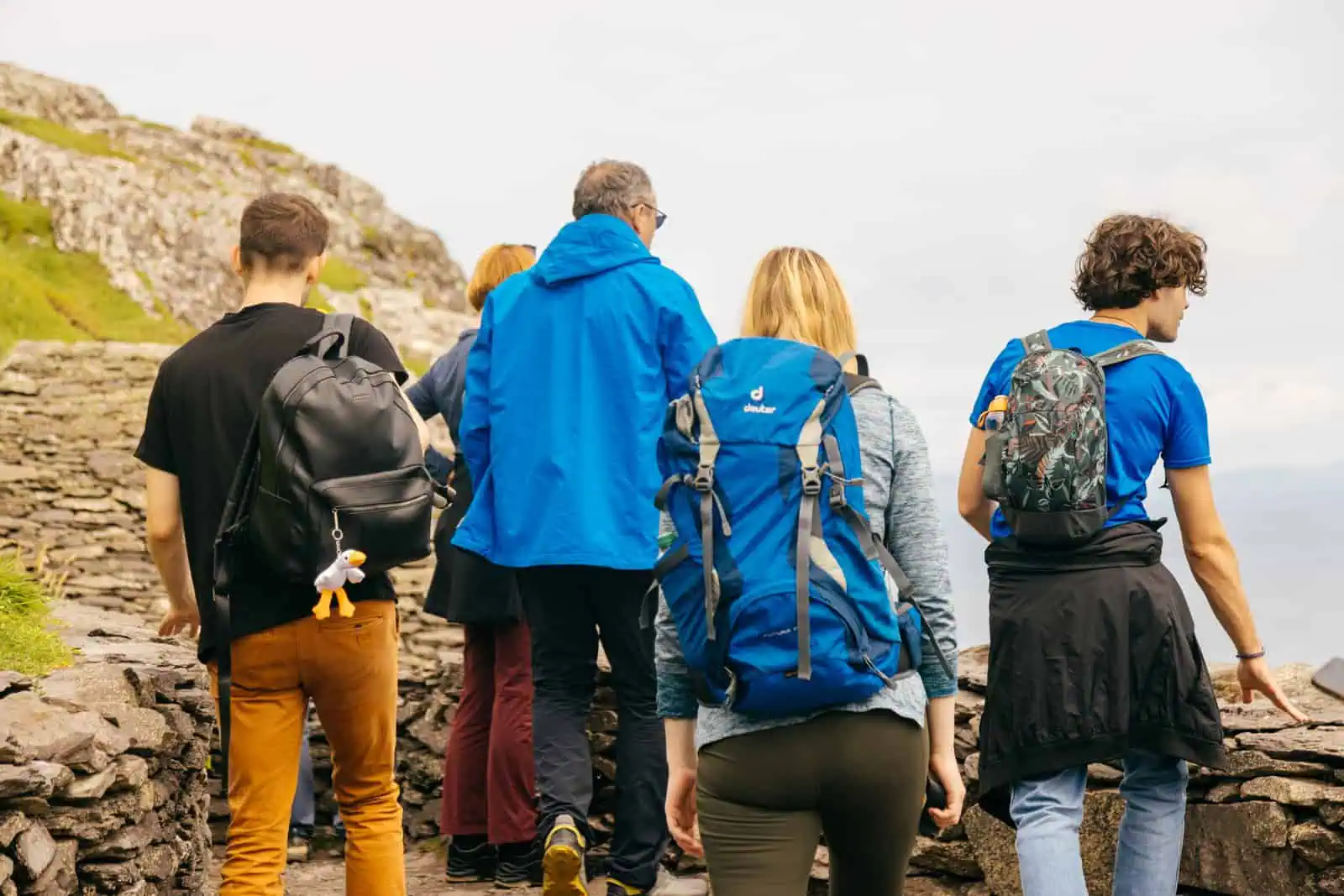
Footwear: You must wear sensible, sturdy footwear with good grip. Suitable options include hiking boots or trainers with treaded soles. Do not wear sandals, flip flops, pumps, heeled shoes, wedges, dress shoes, or smooth-soled footwear as you will be denied boarding.
Waterproofs: Even on sunny days, the Atlantic weather can change in minutes. High-quality waterproof jackets and trousers are essential. Sea spray during the crossing can also soak through standard clothing quickly.
Layers: It is significantly colder on the island and on the open water than it is on the mainland. Wear multiple layers that can be added or removed as needed.
Sun Protection: Despite the wind, the sun can be intense on the rock. Apply sun cream before departing the marina.
What Is Available on the Island
Skellig Michael is a protected heritage site and a sensitive nature reserve. Facilities are extremely limited, so you need to plan accordingly.
There is one toilet on the main pathway just before the start of the 618 steps. It is the only toilet facility on the island, so use it before you begin the climb.
There are no shops, cafes, or drinking water taps. Bring your own water and a packed lunch. If you eat on the island, keep it to appropriate spots away from wildlife and pack away all litter and food waste. This helps avoid attracting gulls and disturbing nesting seabirds and other wildlife.
There are no bins on Skellig Michael, so all rubbish must be taken back with you.
The Boat Crossing
The crossing to Skellig Michael takes approximately 45 minutes depending on sea conditions. As the boat leaves the shelter of the marina, you pass through the Portmagee Channel and enter the open Atlantic. You feel the change in the boat's movement almost immediately. Even on days with moderate winds, the Atlantic swell creates a consistent rolling motion. This is not a harbour cruise. You are in an open environment where sea spray is very common. If you are prone to sea sickness, consider taking preventative measures before the tour. Medication works best when taken before you board, not once you are already on the water.
Along the way you will see Bray Head, the Kerry Cliffs, Puffin Island and the Lemon Rock. As you move further from the coast, the Skellig Islands come into view on the horizon. On the approach, the boat passes close to Little Skellig. This is where you encounter the gannet colony, one of the largest in the world, with tens of thousands of birds covering every available ledge and surface of the rock during the season. The boat then continues to Skellig Michael to show you the lighthouse and other points of interest on the island before proceeding to the landing pier.
Landing on Skellig Michael
The boat approaches Blind Man’s Cove, a small, narrow inlet on the island's eastern side. This is the most technical part of the water-based journey. There is no large dock or gangway. Instead, there is a concrete pier built into the rock. This is the most critical moment, listen carefully to the skipper and crew as they instruct you how to safely disembark the boat.
You must time your step from the boat onto the pier. Crew members are there to assist, but you need a reasonable level of mobility to make this transition. Once you step onto the solid rock of Skellig Michael, the scale of the island becomes immediately clear. You are standing at the base of a 218-metre-high rock rising vertically from the ocean.
The Climb: The 618 Steps and Physical Requirements
From the landing area, you first follow the lighthouse road. This wide path was blasted into the cliff face in the 1820s during the construction of the island's two lighthouses. It runs along the southern and western side of the island and gives you an immediate sense of the scale of the place, with the Atlantic dropping away below you. The road brings you to the base of the main steps. This is where the monk-built route begins. Here an OPW guide will give you a safety briefing before you begin the ascent.
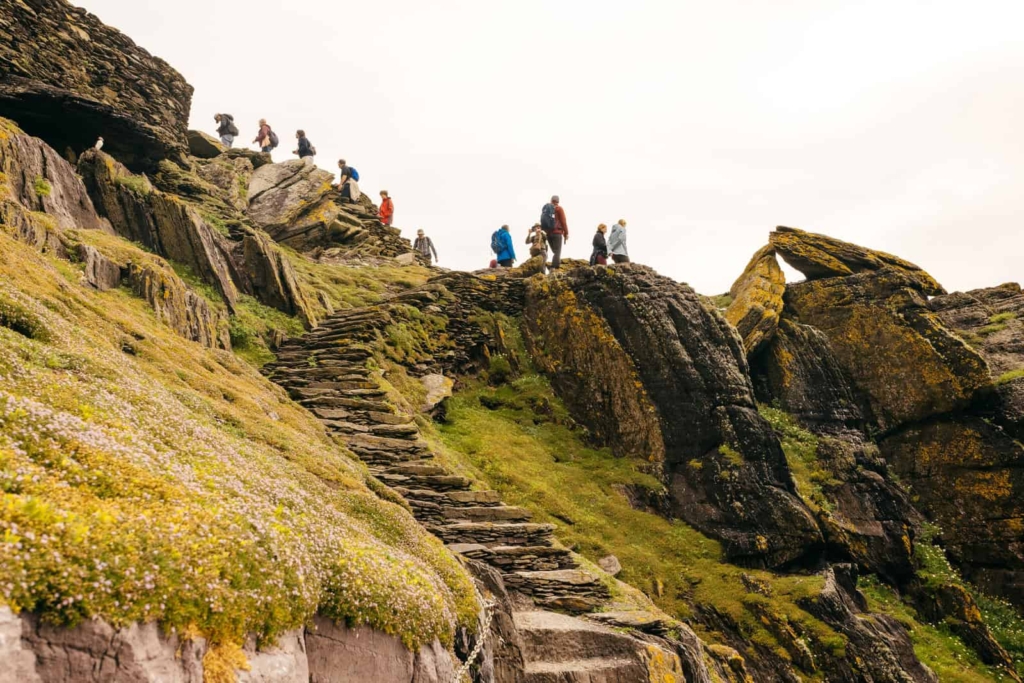
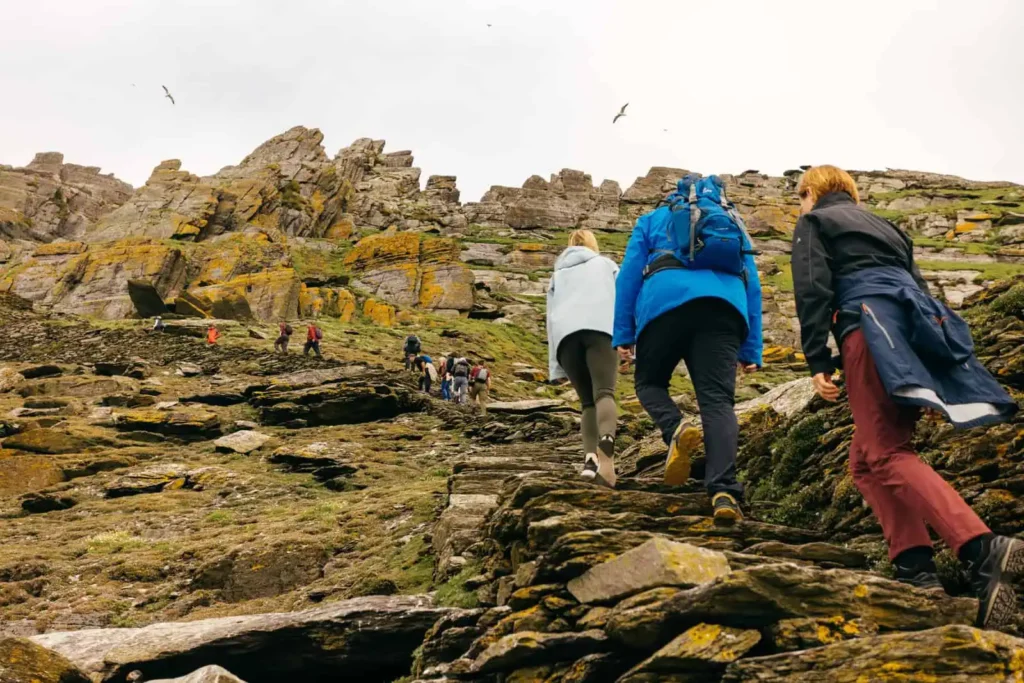
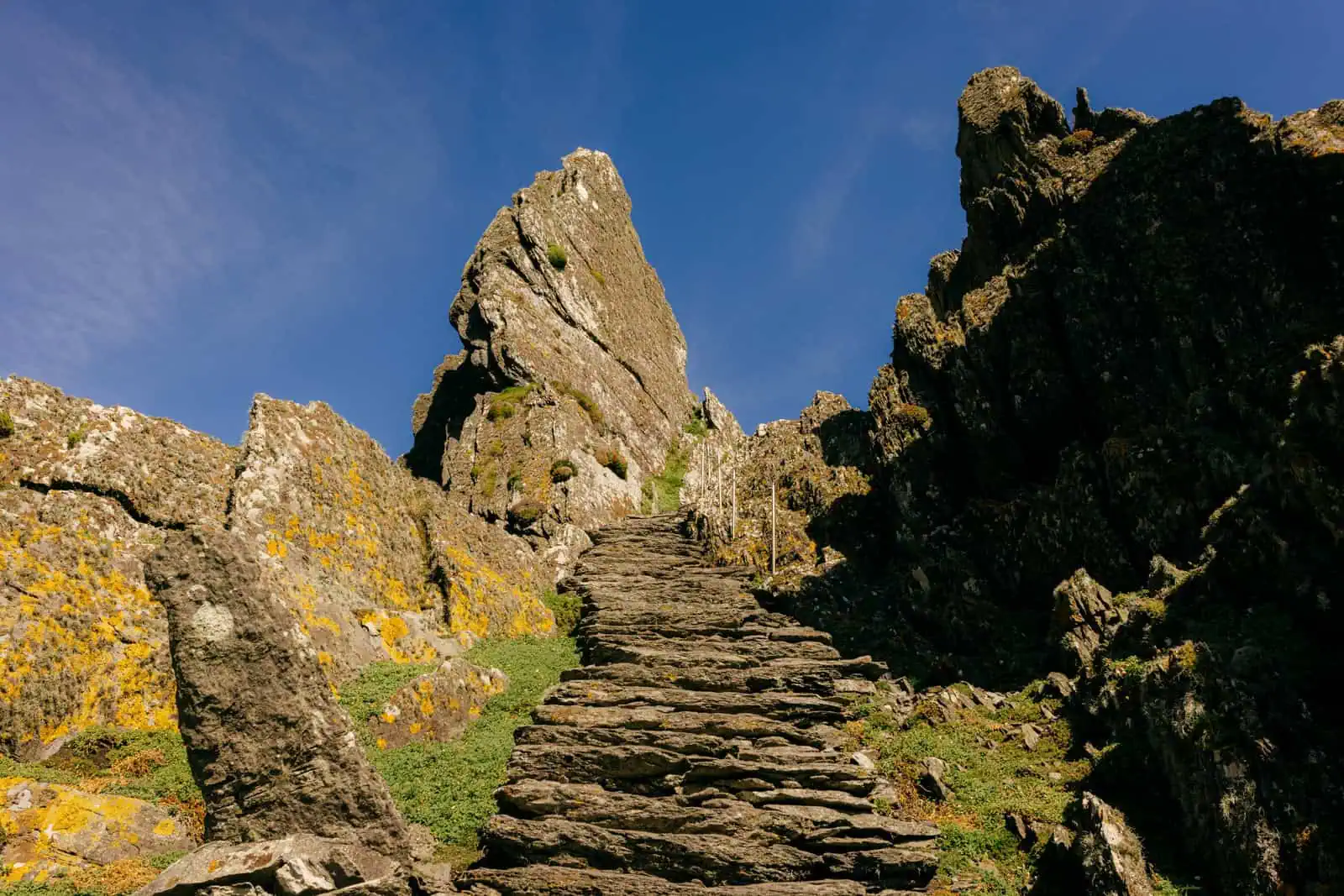
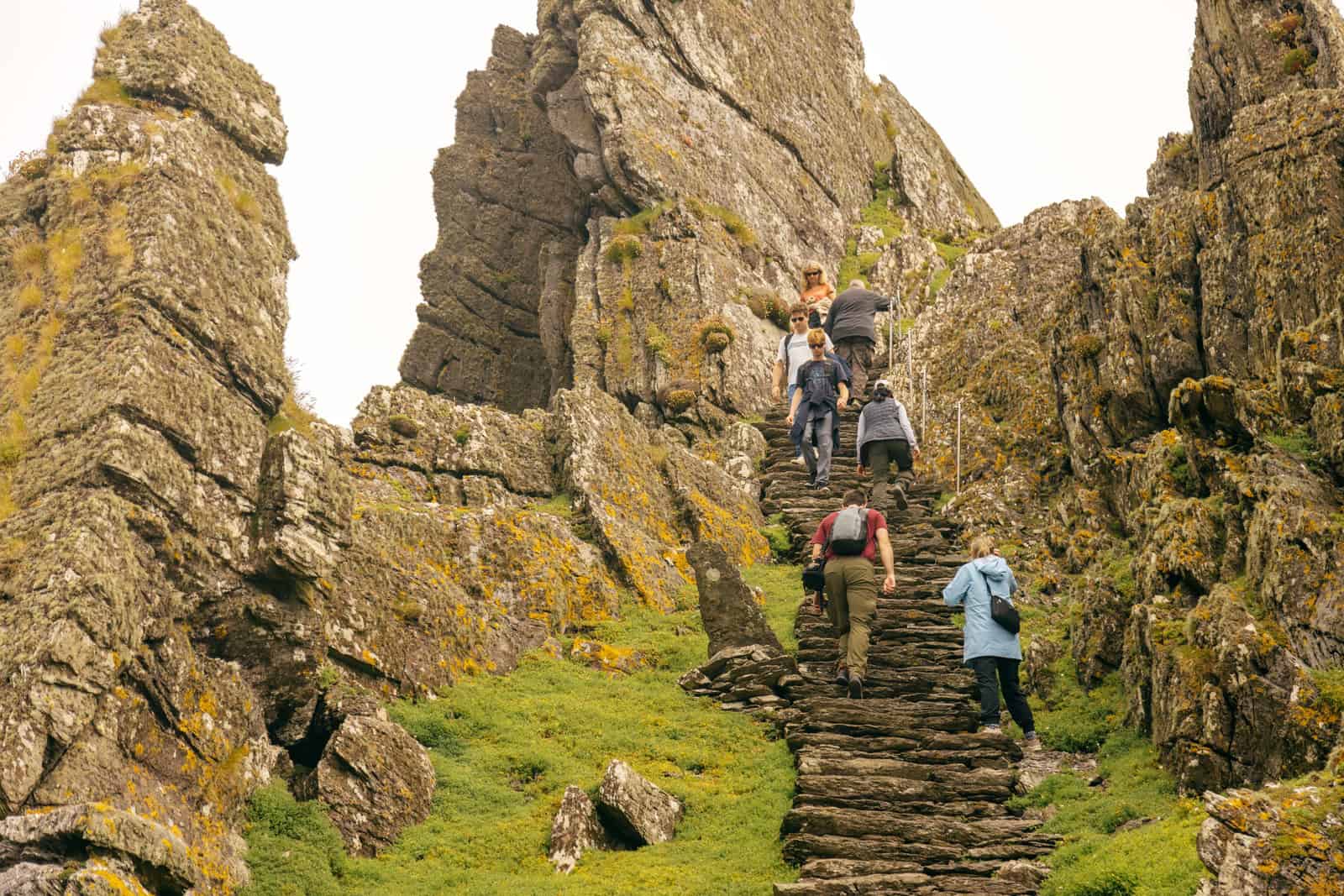
The route is 618 dry-stone steps built by monks over a thousand years ago. The steps are uneven and can be slippery in rain or mist. There are no handrails or safety barriers, and several sections are exposed with significant drop-offs. The steps are not uniform. No two steps are quite the same height, depth or angle. Some are wide and relatively flat. Others are narrow, worn smooth over centuries, and tilted outward toward the drop. This unevenness is the defining physical challenge of the climb. Every step requires attention.
For these reasons, our landing tour is not permitted for children under the age of 14. If you are not comfortable with heights or you struggle with balance, this climb may not be suitable. Move steadily, keep your spacing, and let others pass at the wider points.
The Lower Steps
The lower steps rise steeply from the base of the route through the grassy lower slopes. This is where puffins nest closest to the path, often within a metre or two of where you are walking. Skellig Michael is an active seabird colony, with birds using almost every ledge and surface during the breeding season. If you are visiting between May and July, you can often see puffins close to the steps, so you need to watch where you place your feet and keep your distance. Stay on the main route and never step onto soft ground where birds may be nesting. Keep food packed away except when eating, and take everything back off the island.
Middle Section and Christ's Saddle
The middle section is where the exposure becomes most pronounced. The steps narrow in places. The views open up across the Atlantic and back toward the Kerry coastline. The height becomes something you are aware of continuously. Christ's Saddle is the flat grassy plateau located between the island's two peaks, roughly two thirds of the way up. Most people stop here to take in the view or to have a bite to eat. It is a natural resting point with a clear view of the final approach to the monastery above and the sea far below on both sides. During the breeding season this is one of the most densely populated puffin areas on the island.
Upper Section
The upper steps from Christ's Saddle to the monastery terrace are the most exposed section of the climb. The steps narrow further. The wind is less predictable at this height. The final approach to the monastic terrace requires care even in good conditions.
The full climb from the base of the steps to the monastery takes most people between twenty and forty minutes depending on pace and fitness. There is no requirement to keep up with anyone ahead of you. The steps string groups out naturally and there are passing points throughout the route. If you need to stop, stop. Where people most commonly struggle is on the exposed middle section and on the narrower steps where the drop is most visible.
Reaching the Monastery
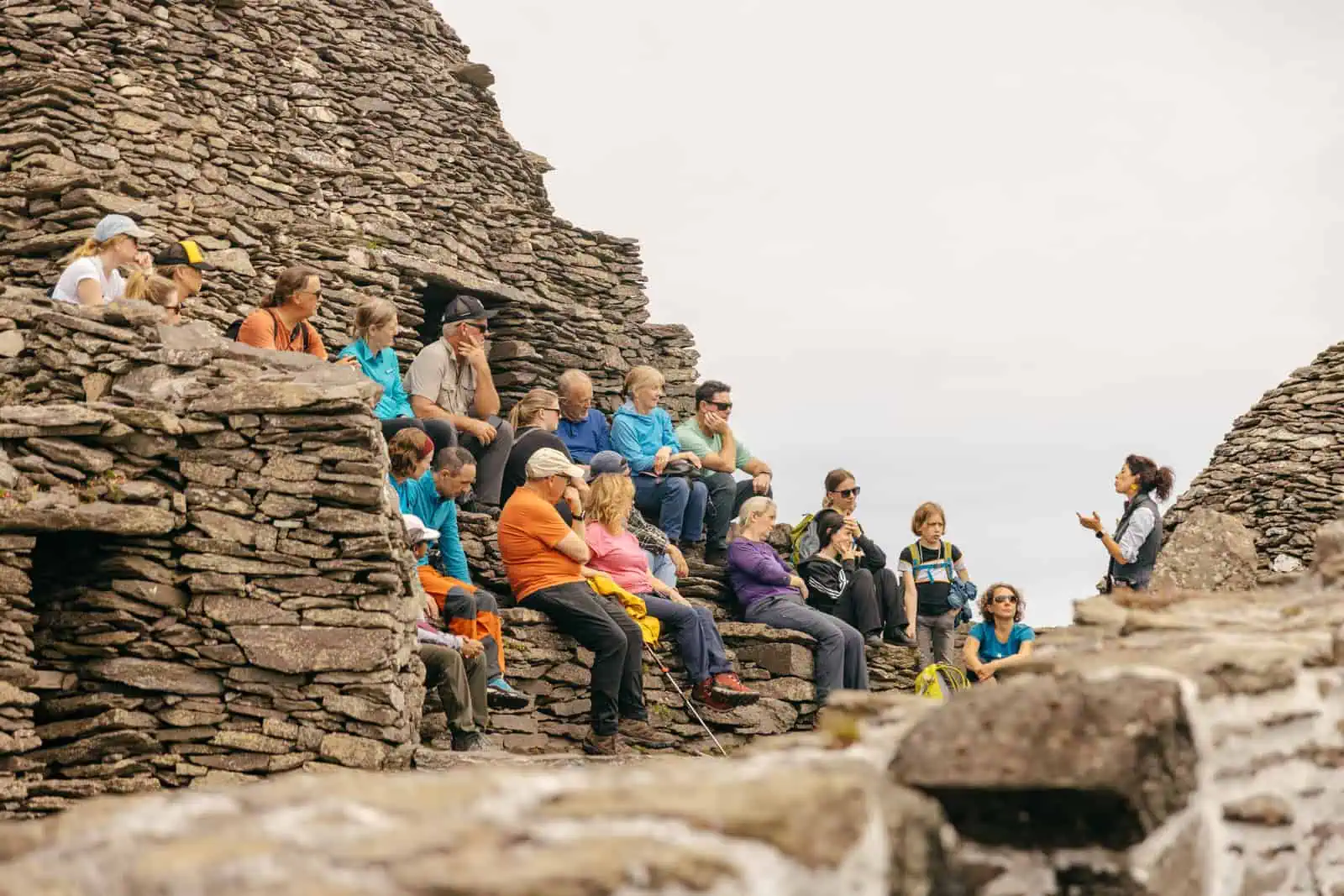
The monastery itself is a feat of early Christian architecture. You see six beehive huts (clocháns), two oratories, and a small garden area. The dry-stone walls have survived for over a thousand years in one of the harshest environments in Europe. You can enter the huts and see how they were constructed using drystone techniques.
You see the remains of the monks' sophisticated water filtration system and their graveyard marked with simple stone crosses. The layout is compact and functional, designed for a small community living in total isolation. You have two and a half hours on the island in total, which allows enough time to explore the monastery before you have to begin your return.
Two OPW guides are stationed inside the settlement and they give a speech about the monastery and the islands so make sure you don't miss it. The guides live and work on Skellig Michael throughout the season so they are very knowledgeable and will be happy to answer any questions you may have.
The Descent
Many visitors underestimate the descent. While it is less cardiovascularly demanding than the climb, it requires more concentration and places more strain on your joints. Your legs may feel fatigued from the ascent, which increases the risk of a trip or slip.
You are now looking directly down the steep slopes you just climbed. The exposure is more noticeable on the descent, as you are facing directly down the slope. You must maintenance focus on every single step. It is standard practice to wait in passing places for those coming up, as the person ascending generally has the right of way.
Weather and Sea Conditions
Landing on Skellig Michael depends entirely on sea conditions at the island’s small landing cove. The landing area is a concrete step exposed to Atlantic swell. If the swell is too high, we cannot transfer passengers safely. This can be the case even if the sky is clear and the sun is shining.
Cancellations can happen at short notice. The Office of Public Works (OPW) staff assess the landing conditions on the morning of your trip and have the final decision on whether landings are permitted. They may cancel immediately or delay the decision if conditions are expected to improve.
If your tour is cancelled, you receive a full refund. Because landing is so restricted and we are often booked months in advance, rescheduling for the following day is rarely possible. When sea conditions permit, we can offer our Skellig Michael Eco Boat Tour instead. It is much more flexible, with multiple trips per day, and it still gives you close views of Skellig Michael and Little Skellig from the water.
Sea conditions, not schedules, determine whether a landing is possible.
Returning to the Mainland
The boat departs Blind Man's Cove once the crew confirm that everyone is on board. The return trip to Portmagee Marina often feels different from the outward journey. The adrenaline of the landing and the climb has faded, and physical fatigue sets in. The boat journey back takes another 45 minutes.
You arrive back at the marina approximately five hours after you first departed. You have completed a demanding physical journey, and now it is time to relax. Portmagee is small but well set up for visitors, with pubs, restaurants, and a café all within a short walk of the marina.