
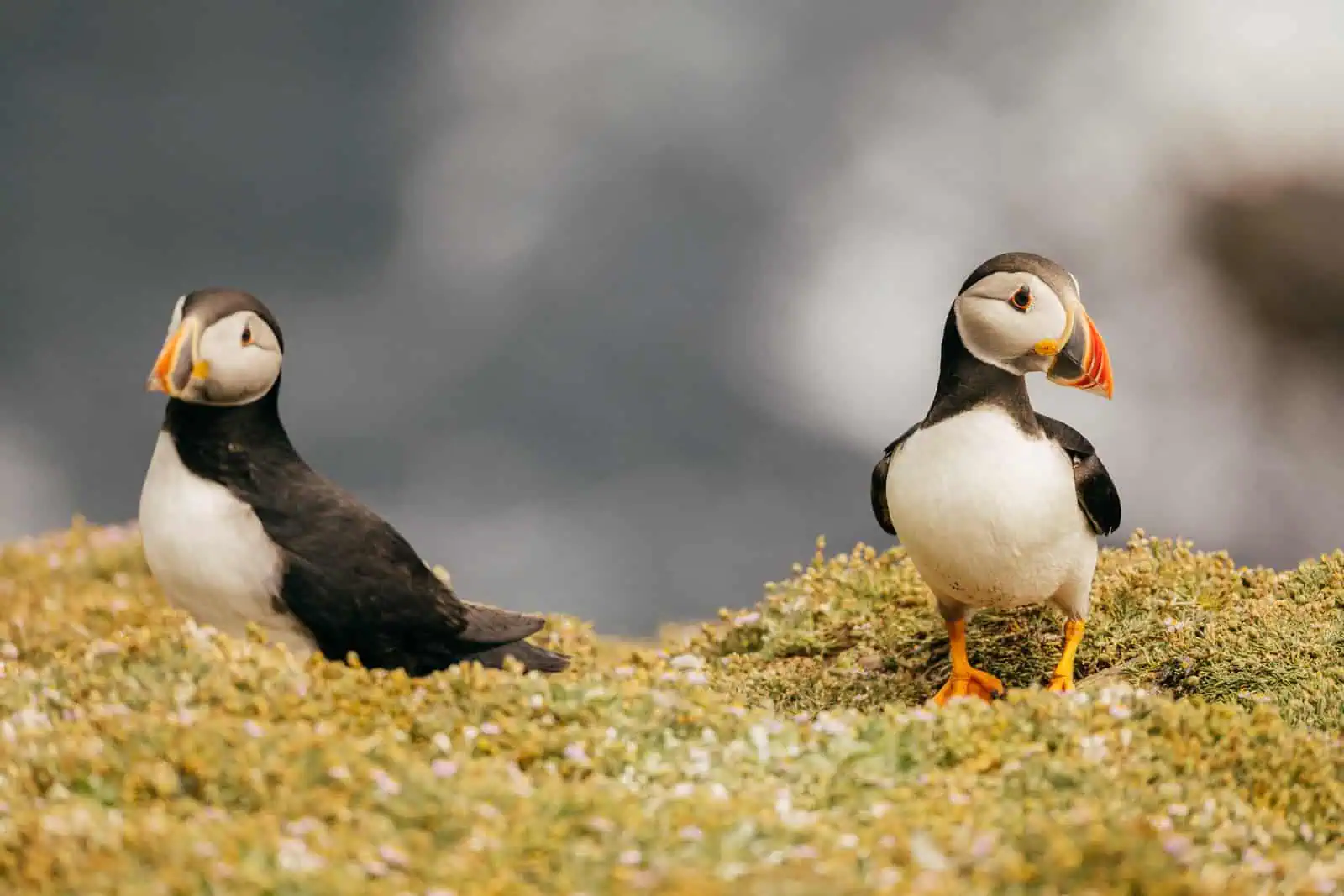
Atlantic Puffins inhabit Skellig Michael for roughly five months each year, usually arriving in late March/early April and departing by mid-August. During this period the island becomes one of Ireland’s most visible puffin breeding sites, with thousands of birds nesting on the grassy slopes. They dig burrows into the soft soil on Skellig Michael, which is not possible on the bare rock of Little Skellig.
Puffin Breeding Season on Skellig Michael
Puffins are only on the island for part of the year. Outside of the breeding months, they are entirely pelagic, meaning they live on the open Atlantic Ocean, often reaching as far as Greenland or Newfoundland.
- Late March to April: Puffins return to the island to reclaim their burrows and find their mates. They often gather in groups on the water before moving onto the land.
- May to Early June: Breeding pairs lay a single egg. Even during incubation, the island remains active with puffins socialising on the grassy slopes or flying between the nesting sites and the sea while their mates tend to the eggs.
- June to July: This is the optimal time for viewing. Once the eggs hatch, the "pufflings" (chick puffins) require constant feeding. Adult birds fly back and forth from the ocean to the burrows throughout the daylight hours.
- August: By early to mid-August, the pufflings fledge, usually under the cover of darkness to avoid predators. The adult population leaves the island almost simultaneously, often leaving the slopes empty by the third week of the month.
Why Puffins Choose Skellig Michael
Puffins require a sufficient amount of soil in order to dig their burrows. On Skellig Michael, the steep, grassy slopes provide this, with burrows often reaching up to a metre in length.
Puffins are secondary burrowers. While they are capable of digging their own holes using their beaks and webbed feet, it’s also common for them to occupy existing burrows. On Skellig Michael, that includes abandoned Manx Shearwater burrows, as well as burrows created by the island’s rabbit population. These burrows provide protection from the elements and from predators like Great Black-backed Gulls and Ravens.
Puffins live in large groups and occupy almost every patch of soil between the landing point and the monastery. Much of the available turf across the island contains burrows, including right next to the visitor paths, which gives you a very close look at them.
The 'Porg' Connection
Skellig Michael was used as a filming location for the recent Star Wars trilogy. During production, puffins were so numerous that the team chose to incorporate them into the Star Wars universe rather than remove them digitally from every shot. They became the inspiration for the "Porgs" featured in Star Wars: The Last Jedi. Check out our Star Wars guide for more behind the scenes details.
Diet and Foraging Behaviour
The survival of the colony depends on the availability of small forage fish in the surrounding Atlantic waters. The puffin’s diet primarily consists of sand eels, sprats, and rockling. A puffin’s beak is specifically adapted for fishing. It features backward-pointing serrations on the upper mandible and a specialised tongue that allows the bird to hold multiple fish against the roof of its mouth while continuing to hunt.
They are proficient divers, using their wings to "fly" underwater. They typically dive to depths of 10 to 20 metres, though they are capable of reaching up to 60 metres if prey is scarce. Other birds, like gulls, often try to steal fish from puffins. On Skellig Michael, gulls wait near the burrows to catch adults returning from the sea. To avoid this, puffins fly in at high speeds and dive straight into their holes.
The health of the puffin colony is a direct indicator of the local marine ecosystem. Large shoals of fish attract not only puffins and gannets but also larger predators such as minke whales and common dolphins, which we sometimes see on our Skellig Islands Eco Tours during the summer months.
Choosing the Right Tour for Puffin Viewing
We offer two ways to see the puffins. You can join our landing tour on Skellig Michael or take our boat tour around the Skellig islands. Both trips leave from Portmagee Marina.
The Skellig Islands Eco Tour
The Skellig Islands Eco Tour stays on the water and circles Skellig Michael and Little Skellig. Puffins are typically seen on the water in groups and flying near the islands. This option also gives you viewing time along Little Skellig, where gannets occupy most available ledges and rock surfaces during the breeding season.
The Skellig Michael Landing Tour
The Skellig Michael Landing Tour includes a boat trip around the islands and a landing on Skellig Michael. Once you land, you'll see puffins nesting along the path to the monastery. This route is physically demanding and involves 618 stone steps. The trip lasts about five hours, with around two and a half hours spent on the island.
Viewing Puffins on Skellig Michael
On our landing tour, puffins are visible almost immediately after you disembark. However, certain areas offer more concentrated viewing:
- The Lower Slopes: As you begin the ascent, the grassy areas beside the lower path are heavily populated with burrows.
- Christ’s Saddle: This is the flat, grassy plateau located between the two peaks of the island. It is one of the most densely populated puffin habitats on the island. It is a popular spot to stop and watch the birds returning from the sea.
- The Monastery: Even at the highest point of the visitor route, puffins occupy the small patches of greenery between the dry-stone beehive huts and the retaining walls.
When observing puffins, please stay on the stone paths to protect the puffins. Their burrows are fragile and can easily collapse if you step on them, which can trap or crush the birds inside. It’s also important to keep a respectful distance so the adults feel safe coming back to feed their chicks.
Logistical Information for Visitors
Puffin viewing is entirely dependent on the weather and Atlantic sea conditions.
- Demand is especially high in July. June is often a better month to book as it is slightly quieter, but puffin activity remains at its peak. We recommend booking your tour well in advance.
- Even in mid-summer, the Atlantic wind is cold. We advise you to wear waterproof clothing and sturdy, non-slip footwear.
- Long lenses are not strictly necessary for puffins on the landing tour because the birds are often within a few metres of the path, but for the Eco Tour a lens with some zoom capability will help capture the birds on the cliffs or on the water.
The experience of seeing thousands of puffins in their natural habitat is a highlight for many visitors to County Kerry. Whether you choose to climb the ancient steps or view the colony from the sea, the period between May and July offers the most reliable window to witness this wildlife spectacle. For more information on the various species found here, you can read our guide on birds on Skellig Michael.